Data Loss Prevention DLP is a critical enterprise security discipline for today’s digital-first organisations. With sensitive data spread across endpoints, cloud environments, and applications, protecting confidential information is no longer optional — and DLP provides the visibility, control, and enforcement needed to keep it secure.
🔍 What Is Data Loss Prevention (DLP)?
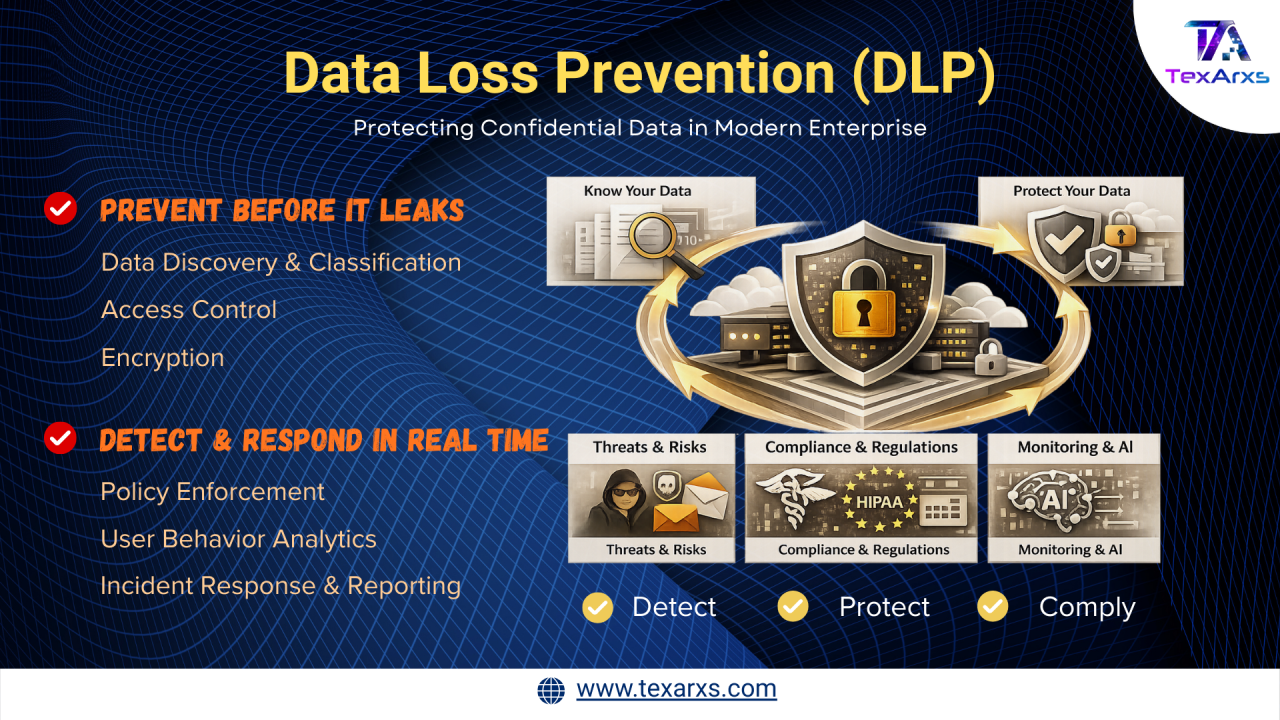
Data Loss Prevention (DLP) is a security solution designed to identify, monitor, and help prevent unsafe or inappropriate sharing, transfer, or use of sensitive data.
A DLP solution enables organisations to:
- Monitor sensitive data across on-premises systems, cloud environments, and endpoint devices
- Prevent accidental or intentional data exposure
- Support regulatory compliance requirements such as HIPAA and GDPR
At its core, DLP helps organisations understand where sensitive data exists, how it is used, and how it should be protected.
🧩 Information Protection and Governance: The Foundation of DLP
Effective DLP is built on two complementary disciplines:
🔷 Information Protection
Applies controls—such as encryption, access restrictions, and visual markings—to safeguard sensitive data.
🔷 Information Governance
Defines the lifecycle of data, including how long it is retained, when it is archived, and when it should be deleted.
Together, they enable organisations to:
- Understand their data
- Protect it appropriately
- Govern it in a compliant and auditable manner
🏗️ The Four Pillars of a Strong DLP Strategy
1. Know Your Data
Understand your data landscape by identifying and classifying sensitive and business-critical data across hybrid environments.
Example: Identifying documents that contain personal identifiers or regulated information before they are shared externally.
2. Protect Your Data
Apply safeguards such as encryption, access controls, and data markings to reduce exposure risk.
3. Prevent Data Loss
Help employees avoid accidental oversharing by enforcing policies at the moment data is accessed, shared, or transferred.
4. Govern Your Data
Ensure data is retained, deleted, and stored according to regulatory and organisational requirements.
🛡️ How Does DLP Work?
DLP is a combination of people, processes, and technology working together.
A DLP solution:
- Analyzes data using policies defined by the organisation
- Uses technologies such as antivirus, AI, and machine learning
- Detects suspicious or non-compliant activities
- Prevents data exposure without disrupting business operations
Instead of reacting after a breach, DLP focuses on prevention and visibility.
⚠️ Common Types of Data Threats
🔷 Cyberattacks
Malicious attempts to steal, modify, or destroy data—such as DDoS attacks, spyware, or ransomware.
🔷 Insider Risks
Employees, contractors, vendors, or partners misusing authorized access—either intentionally or unintentionally.
🔷 Phishing
Fraudulent communications designed to trick users into revealing sensitive information like passwords or financial details.
🔷 Malware
Malicious software disguised as trusted attachments or applications that grant unauthorized access once opened.
🔷 Unintentional Exposure
Accidental data leaks caused by misconfigured access, human error, or lack of awareness.
🔷 Ransomware
Malware that blocks access to systems or data until a ransom is paid, often targeting organisations through coordinated attacks.
💻 Why Is DLP Important?
DLP is a critical part of an organisation’s risk-reduction strategy, especially for securing endpoints such as:
- Laptops and desktops
- Mobile devices
- Servers
It also aligns with broader Information Security (InfoSec) practices, including:
- Infrastructure and cloud security
- Cryptography
- Incident response
- Disaster recovery planning
📈 Key Benefits of a DLP Solution
🔷 Classify and Monitor Sensitive Data
Understand what data exists and how it is used to identify unauthorized access and reduce misuse.
🔷 Automate Data Classification
Automatically evaluate factors such as data location, creation time, and sharing patterns to enforce DLP policies at scale.
🔷 Monitor Data Access and Usage
Use identity and access controls—such as role-based access—to ensure only the right users access sensitive data.
🔷 Detect and Block Suspicious Activity
Prevent data from leaving the organisation via email, removable media, or unauthorized uploads.
🔷 Maintain Regulatory Compliance
Support audits and reporting for regulations such as HIPAA, SOX, and FISMA, including data retention and employee training requirements.
🔷 Improve Visibility and Control
Gain insight into where sensitive data resides, who accesses it, and where risks exist—enabling continuous improvement of security posture.
🎯 DLP Adoption and Deployment Considerations
To deploy DLP successfully and with minimal disruption, organisations should:
- Document the deployment process for operational continuity and audits
- Define clear security requirements to protect intellectual property and personal data
- Establish roles and responsibilities, ensuring separation of duties between policy creation and implementation
These steps reduce misuse and strengthen accountability.
🧠 DLP Best Practices
To ensure long-term success:
- Identify and classify sensitive data
- Encrypt data at rest and in transit
- Secure systems by limiting access to only those who need it
- Implement DLP in phases, starting with pilot deployments
- Maintain a strong patch management strategy
- Automate wherever possible to scale effectively
- Use anomaly detection to identify abnormal behavior
- Educate employees on their role in data protection
- Track metrics such as incident frequency and response time
🚀 DLP Solutions and the Path Forward
Data threats are inevitable—it’s not a matter of if, but when. Choosing the right DLP solution requires planning, research, and alignment with organisational goals.
Supporting capabilities may include:
- User behavior analytics
- Security education and awareness
- Encryption
- Data classification
- Cloud access security brokers (CASB)
- Insider risk management tools
Solutions such as Microsoft Purview help organisations achieve governance, protection, and compliance across platforms, applications, and cloud environments.
💼 Final Thought
Data Loss Prevention is not just a security control—it is an operational discipline. When implemented correctly, DLP empowers organisations to protect sensitive data, support compliance, and enable employees to work securely without friction.